
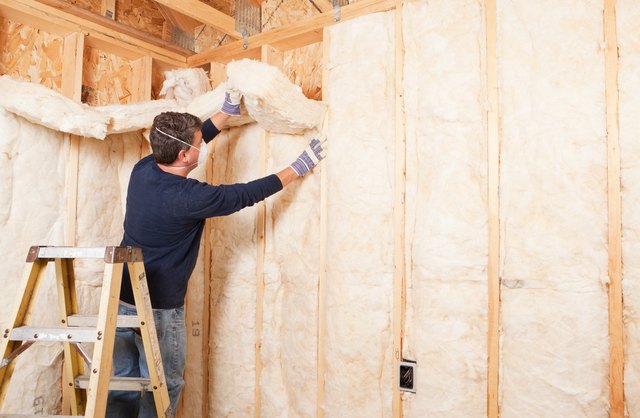
Faced insulation has a vapor barrier or a vapor retarder (the facing) that helps prevent moisture from moving from one space to another. The facing also helps protect the surface, hold the insulation together and fasten the material to building components.
Table of Contents
READ ALSO

Unfaced means the insulation lacks a vapor retarder (paper or plastic facing). Kraft-faced insulation includes a paper vapor retarder, which helps prevent mold and mildew. … The insulation should be snug in the cavity, but not compressed.
Thereof, How do you keep insulation Unfaced?
Place unfaced insulation on top of existing material, such as loose-fill cellulose. Press the insulation firmly into place between joists, taking care to not compress the fiberglass and reduce its efficiency. Fasten batts loosely to perpendicular joists with plastic straps just to keep it from shifting.
Also to know is, How do you keep unfaced insulation from falling down? Accordingly, how do you hold insulation in the ceiling? Install unfaced batts by stuffing them between the joists in the same way, but use polyester twine to hold them in place. Thread the twine between the joists, attaching it to the sides of the joists with drywall screws or roofing nails.
Subsequently, question is, Can you use unfaced insulation on exterior walls? Unfaced means the insulation lacks a vapor retarder (paper or plastic facing). … Kraft-faced insulation should be installed in exterior walls, exterior basement walls, and attic ceilings by pressing the product into the wall cavity with the paper side facing outward, towards the installer.
Also, When should I use unfaced insulation?
Unfaced insulation—the type without paper—is what you would use if you are adding insulation to your attic or to place between floors when living space is above and below. Unfaced is also your best choice for adding soundproofing to interior walls.
What’s the difference in faced and unfaced insulation?
Unfaced means the insulation lacks a vapor retarder (paper or plastic facing). Kraft-faced insulation includes a paper vapor retarder, which helps prevent mold and mildew. … The insulation should be snug in the cavity, but not compressed.
How do you install insulation on exterior walls?
How do you use unfaced insulation?
Unfaced insulation—the type without paper—is what you would use if you are adding insulation to your attic or to place between floors when living space is above and below. Unfaced is also your best choice for adding soundproofing to interior walls.
What is difference between faced and unfaced insulation?
Unfaced means the insulation lacks a vapor retarder (paper or plastic facing). Kraft-faced insulation includes a paper vapor retarder, which helps prevent mold and mildew. … The insulation should be snug in the cavity, but not compressed.
What’s the difference between faced and unfaced fiberglass insulation?
Unfaced means the insulation lacks a vapor retarder (paper or plastic facing). … Kraft-faced insulation includes a paper vapor retarder, which helps prevent mold and mildew.
Which side of insulation goes down?
Regardless of whether fiberglass insulation is installed in a wall, attic, or crawlspace; the paper facing should always face toward the inside of the home. That’s because the paper contains a layer of asphalt adhesive which prevents water vapor from passing through it.
Does unfaced insulation need a vapor barrier?
In cold climates, a vapor barrier is almost always needed. The facing on faced insulation acts as a vapor retarder. If you need a vapor barrier and your insulation is unfaced, you must cover it with a polyethylene film.
What is the correct way to install insulation?
Regardless of whether fiberglass insulation is installed in a wall, attic, or crawlspace; the paper facing should always face toward the inside of the home. That’s because the paper contains a layer of asphalt adhesive which prevents water vapor from passing through it.
How do I keep my insulation from falling down?
A. After pushing the batts up into place between the joists, you can use thin wire woven back and forth between nails driven part way into the bottom of the joists. Or, you can buy pieces of stiff wire that have pointed ends and then jam them up between the joists at intervals of about 20 inches.
Is a vapor barrier necessary?
(Source: U.S. Department of Energy.) A vapour barrier is an important component in building construction. Its purpose is to help prevent water vapour from reaching building walls, ceilings, attics, crawlspaces or roofs, where it can condense and cause building materials to rot or grow mould.
Can you staple unfaced insulation?
using unfaced batts or rolls, allow friction to hold the insulation in place (called “friction fit method”). If a polyethylene vapor retarder is used, staple it across the unfaced batts.
Should I use faced or unfaced insulation on my walls?
In most climates, it needs a vapor barrier. Some builders rely on batts with attached kraft-paper facing to do that job, but Tom recommends unfaced batts, covered in plastic with all the seams taped shut.
Don’t forget to share this post 💖
References and Further Readings :